

Quick Answer: To backup Thunderbird emails to external hard drive, copy your Thunderbird profile folder to the drive. The same steps work for any hard drive or USB drive.
- Close Thunderbird completely.
- On Windows, press Win + R, type
%APPDATA%\Thunderbird\Profilesand press Enter. On Mac, use Go > Go to Folder and type~/Library/Thunderbird/Profiles. On Linux, open~/.thunderbird. - Copy the profile folder (for example,
xxxxx.default-release). - Paste it onto your external hard drive and add today’s date to the folder name.
- Compare the size of the copy with the original, then eject the drive safely.
You can easily backup Thunderbird emails to external hard drive or any hard drive using several reliable methods like copying the profile folder, using Thunderbird’s built-in export feature, exporting folders as MBOX with an add-on like ImportExportTools NG, saving individual emails as EML files, or using a backup software tool.
It’s important to keep a backup of your mails at a safe place like a hard drive before updating or changing anything. This guide covers details of these methods that can help you with your backup of Mozilla Thunderbird, what each one secures, and how to restore your backed up mails.
-
- Why Backup Thunderbird Emails to Hard Drive?
- Internal vs External Hard Drive: Which is Better to Save Thunderbird Backup?
- Where Is the Thunderbird Profile Folder on Windows, Mac and Linux?
- 5 Methods to Backup Thunderbird Emails to External Hard Drive
- Method 1: Copy the Thunderbird Profile Folder to an External Hard Drive
- Method 2: Export Thunderbird to Hard Drive Using Built-in Export
- Method 3: Export Thunderbird Folders as MBOX to an External Hard Drive
- Method 4: Save Emails as EML Files to Hard Drive
- Method 5: Use Backup Software When Manual Methods Are Not Enough
- Common Problems When You Backup Thunderbird Emails to Hard Drive
- How to Restore a Thunderbird Backup from an External Hard Drive
- Best Practices
- Conclusion
- FAQs
Why Backup Thunderbird Emails to Hard Drive?
You should always keep a backup of your Thunderbird emails on a hard drive because the emails in your local folders, or those downloaded using POP3, exist only on your computer. If your computer’s internal hard drive fails, files get accidentally deleted, or malware or a faulty update hits your system, you can lose all your data. A backup on an external hard drive lets you restore the files when you need them.
Situations when a backup option can really help are–
- When you are buying a new computer or reinstalling the whole operating system.
- When you switch your server from IMAP to POP3.
- When you are cleaning up your large folders.
- When you are installing or updating Thunderbird to its latest version.
Internal vs External Hard Drive: Which is Better to Save Thunderbird Backup?
Saving your backup on the same internal hard drive as Thunderbird will not protect you if that drive fails or the system is reinstalled. An external hard drive or USB drive keeps the backup separate from your computer, so you can still recover your emails after a crash, theft, or malware attack.
| Point | Internal Hard Drive | External Hard Drive |
|---|---|---|
| If the computer fails | Backup is lost with the system | Backup stays safe |
| Portability | Fixed inside the computer | Can move to a new computer |
| Best use | Temporary working copy | Long-term backup |
Check these points before you copy anything to the drive:
- Free space: The drive should have more free space than the size of your Thunderbird profile folder.
- Drive format: Use NTFS for Windows, APFS for Mac, or exFAT if you use the drive on both.
- Avoid FAT32: FAT32 cannot store a single file larger than 4 GB. Thunderbird stores each folder as one large MBOX file, so a big Inbox can fail to copy to a FAT32 drive.
Where Is the Thunderbird Profile Folder on Windows, Mac and Linux?
You can open the profile folder from Help > Troubleshooting Information > Open Folder, or go to it directly using these default locations:
| Operating System | Default Profile Location |
|---|---|
| Windows | %APPDATA%\Thunderbird\Profiles |
| Mac | ~/Library/Thunderbird/Profiles |
| Linux | ~/.thunderbird |
| Linux (Snap) | ~/snap/thunderbird/common/.thunderbird |
| Linux (Flatpak) | ~/.var/app/org.mozilla.Thunderbird/.thunderbird |
Note– On Windows, paste %APPDATA%\Thunderbird\Profiles into the File Explorer address bar. On Mac, use Go > Go to Folder in Finder. On Linux, press Ctrl + H in your file manager to show hidden folders.
5 Methods to Backup Thunderbird Emails to External Hard Drive
To backup Thunderbird emails to external hard drive, there are 5 easy methods which you can use to get efficient results-
- Method 1: Copy the Thunderbird Profile Folder to an External Hard Drive
- Method 2: Export Thunderbird to Hard Drive Using Built-in Export
- Method 3: Export Thunderbird Folders as MBOX to an External Hard Drive
- Method 4: Save Emails as EML Files to Hard Drive
- Method 5: Use Backup Software When Manual Methods Are Not Enough
Method 1: Copy the Thunderbird Profile Folder to an External Hard Drive
You can have a complete Thunderbird profile backup by copying the profile folder to an external drive, as it saves mails, settings, contacts, and passwords together.
Steps to follow-
- Open Thunderbird and click the three horizontal lines at the top right. Select Help, then Troubleshooting Information (in some versions, Help > More Troubleshooting Information).
- Under the Application Basics heading, find Profile Folder and click the Open Folder button (Show in Finder on Mac).
- Close Thunderbird completely but keep the folder window open. Do not copy files while Thunderbird is running.
- Go up one level in the folder window, so you can see the whole profile folder, like
xxxxx.default-release. - Connect your external hard drive, then copy the profile folder to it.
- Rename the copy by adding the current date so that you can keep a record of the backup.
Method 2: Export Thunderbird to Hard Drive Using Built-in Export
New Thunderbird versions can export your profile to a single ZIP file. This is one of the simplest methods to backup Thunderbird emails to hard drive as it does not require any add-ons.
Steps to follow–
- Optional: click File > Compact Folders and wait for the status bar to finish. This removes deleted messages and can reduce the backup size.
- Open the Application menu (three horizontal lines) or the Tools menu and select Export. If you do not see it, open Settings and search for Export, as the location depends on your version.
- Check the estimated size shown and make sure your external hard drive has enough free space.
- Click Export, choose a location on your external hard drive and save the file. Thunderbird may close itself during the export, so wait until it finishes.
Note– If your version has no Export option, or the export fails on a very large profile, use Method 1 instead.
Method 3: Export Thunderbird Folders as MBOX to an External Hard Drive
The ImportExportTools NG add-on helps you save selected folders or a whole Thunderbird account as MBOX files. This works better when you need to save specific folders rather than the entire Thunderbird profile.
Steps to follow–
- In Thunderbird, click the three horizontal lines at the top right, select Add-ons and Themes and search for ImportExportTools NG.
- Install this add-on and restart Thunderbird.
- Right-click the folder you want to save.
- Select ImportExportTools NG, click Export folder and select the desired format.
- Select the location on your external hard drive where you want to save the folder.
Point to consider– Check the add-on’s compatibility with your Thunderbird’s current version before installing. This will help you get your Thunderbird mail export without any system errors.
Method 4: Save Emails as EML Files to Hard Drive
If you have a small set of important messages to backup, you can drag emails out of Thunderbird to save each one of them as an EML file on your hard drive.
Steps to follow–
- Select the emails you want to save as a backup from the message list.
- Drag the emails to a folder on your hard drive, or right-click and choose the Save as option.
- Thunderbird will save each message as a
.emlfile which you can open later easily.
Also read: Recover Deleted Messages from Thunderbird Email – Guide
Method 5: Use Backup Software When Manual Methods Are Not Enough
This is the fastest and most reliable method to backup Thunderbird emails to your external hard drive without facing any error or technical difficulty. SysTools provides a Thunderbird Backup Software which helps you take the backup of your mails and enables you to export it in any format, such as Outlook PST, MBOX, EML, MSG, and PDF. This will help you take the backup easily without requesting for any technical formalities.
Steps to follow-
- Install and download the tool on your desktop (Free of cost).
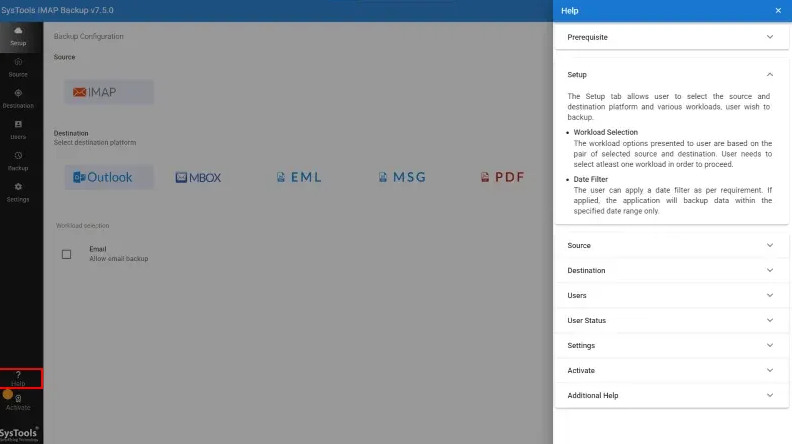
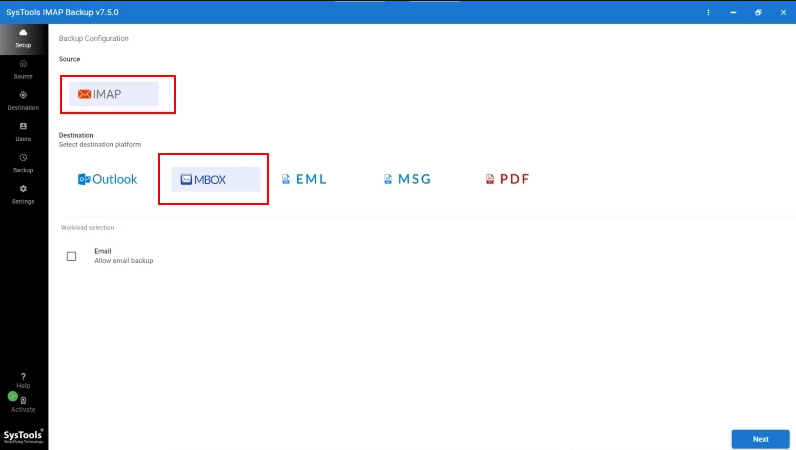
- Click the Setup tab and confirm IMAP as the selected source platform. For destination, choose a format in which you want to save your files.
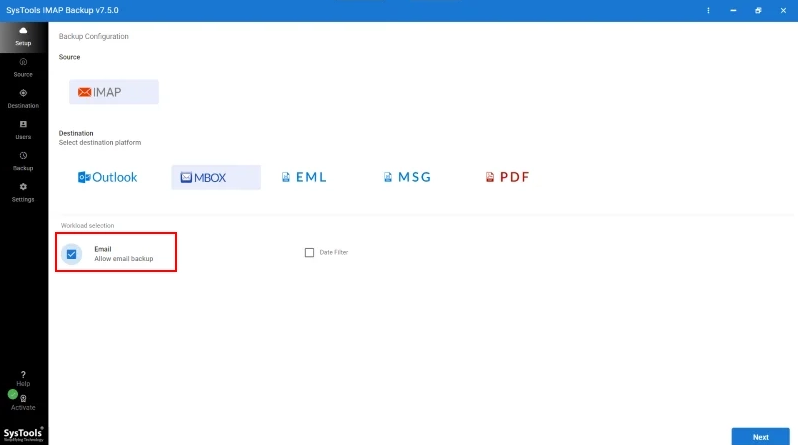
- Now under Workload, select the Email checkbox to enable the email export. Add date filters if required.
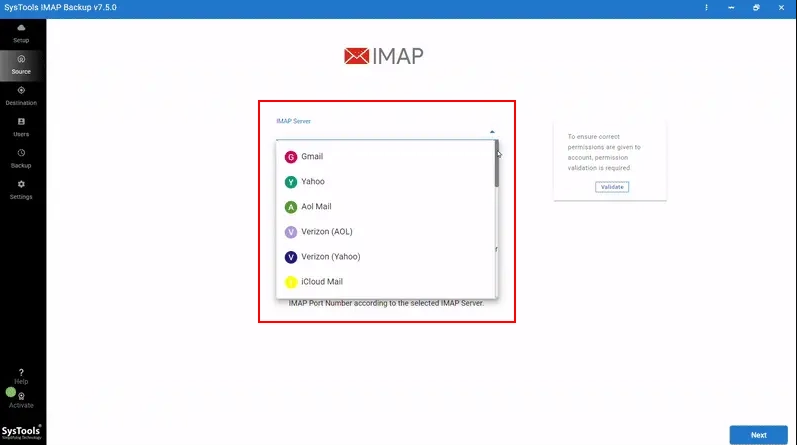
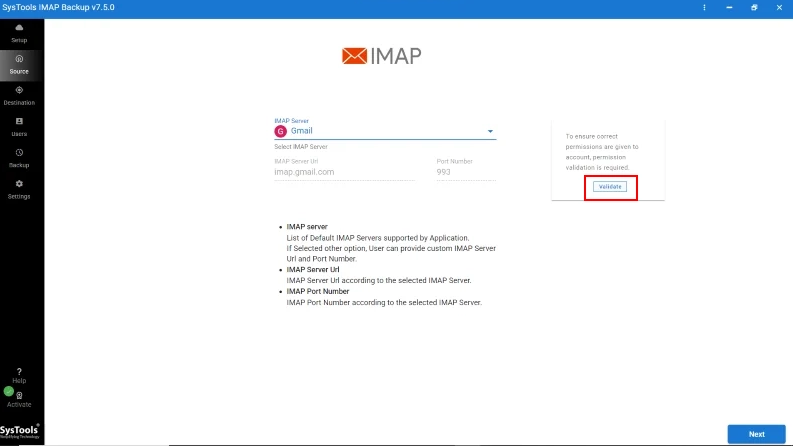
- Now click on the Source and select your email provider from the given dropdown list.
- Click Validate button present under the credentials box and click Next.
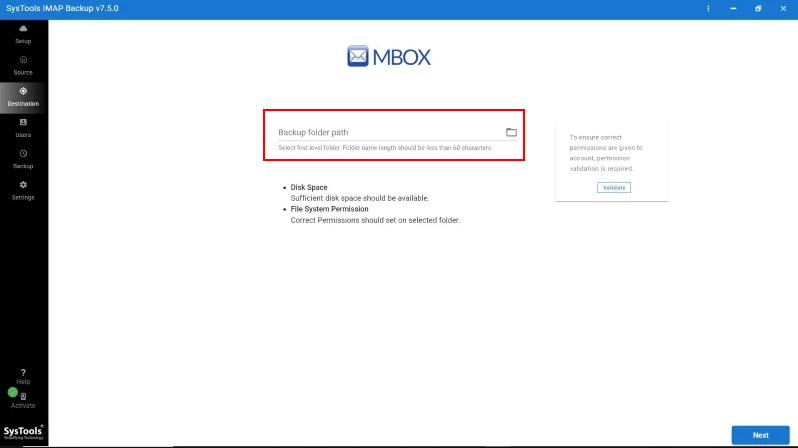
- Now, select Destination button on the bar and select the backup folder path where your files will be saved. Click Validate and confirm the path.
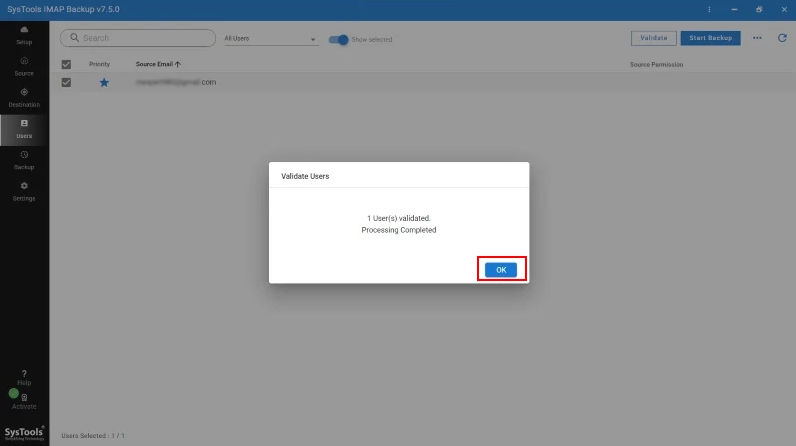
- Go to Users and add user(s) to start the process. Validate the users and click OK as the pop-up message appears.
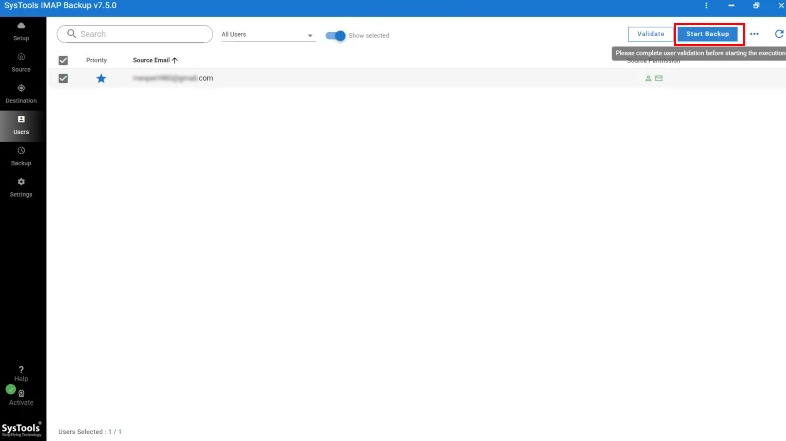
- Now click Start backup to initiate the process.
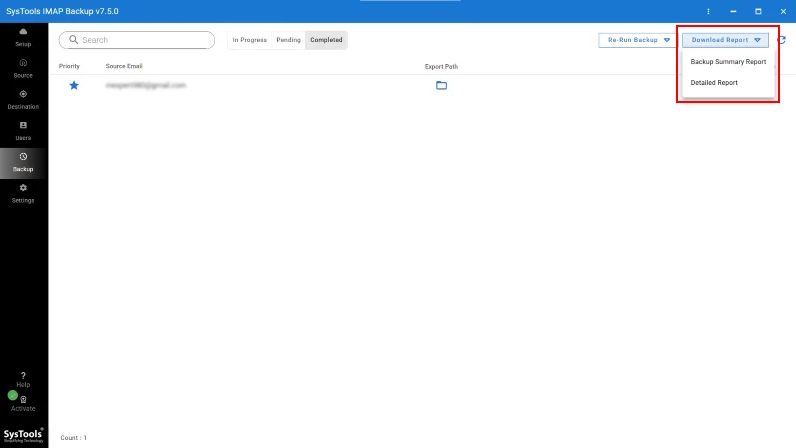
- When every file is successfully backed up, click on Download report to get Thunderbird email save details.
Important: Verify Your Thunderbird Backup on the External Hard Drive
Compare sizes of the file before and after backup to ensure a successful backup. Also, check the key files like Mail and ImapMail folders, prefs.js, logins.json and key4.db are present.
Note: Pulling the drive out while files are still being written can corrupt the backup.
Common Problems When You Backup Thunderbird Emails to Hard Drive
If your backup fails or looks incomplete, check these causes first.
| Problem | Fix |
|---|---|
| “File in use” error while copying | Thunderbird is still running in the background. Close it fully and check Task Manager (Windows) / Activity Monitor (Mac), then copy again. |
| A large folder will not copy to the drive | The drive is probably formatted as FAT32, which has a 4 GB file limit. Copy to a drive formatted as NTFS, exFAT or APFS. If you reformat, move your existing data off the drive first, because formatting erases it. |
| Not enough space on the drive | Run File > Compact Folders in Thunderbird first to remove deleted messages, then check the profile size again. |
| Built-in ZIP export stalls or fails on a very large profile | Copy the profile folder manually (Method 1), or export folders as MBOX using ImportExportTools NG (Method 3). |
| Backup is much bigger than expected | The search index file (global-messages-db.sqlite) may be included. With Thunderbird closed, you can skip this file when copying. Thunderbird rebuilds the index when it starts. |
| Backup folder is missing emails | An IMAP folder may have never been downloaded to your computer. Open each IMAP folder in Thunderbird so it syncs locally, or enable offline use for the folder, then copy the profile again. |
How to Restore a Thunderbird Backup from an External Hard Drive
You can restore your Thunderbird emails on the same computer or on a new one. Connect the external hard drive, then use the replacement method first. If Thunderbird does not show your emails afterwards, use the Profile Manager method.
Method A: Restore by Replacing the Profile Folder
- Install Thunderbird if it is not installed. Open it once and then close it completely. This creates a fresh profile folder.
- Connect the external hard drive that holds your backup.
- Open the new profile folder using the paths in the profile folder section above.
- Delete the contents of the new, empty profile folder.
- Open your backed-up profile folder on the drive and copy all of its contents into the new profile folder. Include
prefs.js, theMailandImapMailfolders,logins.jsonandkey4.db. - Start Thunderbird and check your accounts, folders and recent emails.
Method B: Restore Using the Profile Manager
Use this method if Thunderbird opens with empty folders, does not find your backup, or if you are moving between operating systems.
- Copy the backed-up profile folder from the external drive to your computer, for example into your Documents folder.
- Close Thunderbird, then open the Profile Manager:
- Windows: Press Win + R, type
thunderbird.exe -Pand press Enter. - Mac: Open Terminal and run
/Applications/Thunderbird.app/Contents/MacOS/thunderbird-bin -P
- Windows: Press Win + R, type
- Click Create Profile, then Next, and give the profile a name.
- Choose Folder and select the backed-up profile folder you copied in step 1.
- Finally click on Finish, select the new profile in the list, and click Start Thunderbird.
Note– Select the profile folder itself, the one that contains prefs.js and the Mail folder, not the parent Profiles folder.
Method C: Restore MBOX or EML Files
If you backed up folders as MBOX with ImportExportTools NG, install the add-on in Thunderbird, right-click the folder where you want the emails, and choose ImportExportTools NG > Import mbox file. For EML files, drag them from the external drive into a Thunderbird folder.
Tip– Use the same Thunderbird version, or a newer one, when restoring. Restoring a backup from a newer version into an older one can cause settings errors.
5 Things to Keep in Mind Before Backup
- Always keep two copies of your files, one on your external hard drive and one in the cloud or another location.
- Do not save your only backup on the same internal drive as Thunderbird.
- Close the Thunderbird application before copying or restoring a profile folder.
- Keep relevant names for backup folders, such as the backup date, so that you know which one is the latest.
- Test restoring a copy of the backup on another computer now and then.
Conclusion
The process to backup Thunderbird emails to external hard drive can protect your important messages from system failure or accidental deletion. Copying the profile folder to the drive is the most reliable manual method, while the built-in export and the ImportExportTools NG add-on are useful when you need a single ZIP file or selected folders. If you need other formats or have many mailboxes, a backup software tool can help. Before relying on a backup, keep a second copy in another location and test a restore now and then. With these methods, you can easily backup your Thunderbird emails to hard drive in minutes and recover them whenever you need.
Also read: How to Import MBOX to Mac Mail?
FAQs
- Does Thunderbird have an automatic backup option?
No. Thunderbird does not back up your mail on its own. IMAP accounts keep a copy on the server, but that is not a backup. Local folders exist only on your computer unless you copy them. - If I delete emails from Thunderbird, will they also be deleted from the backup?
No. A backup is a completely separate copy. Deleting emails in Thunderbird does not change the backup unless you use a sync tool. - How do I know if the Thunderbird email export worked?
Compare the size of the backup with your profile folder and open a few files to check that they were copied correctly. A backup software tool can also give you a report of pending or incomplete items. - Can I restore my backup to a newer version of Thunderbird?
Yes. You can restore your emails and data into a newer version of Thunderbird. Install the latest version before restoring. - Can I encrypt my Thunderbird email download in hard drive?
Yes. You can put your backup folder in a password-protected ZIP file or store it on an encrypted drive. This is worth doing because the backup contains all your emails and saved passwords.